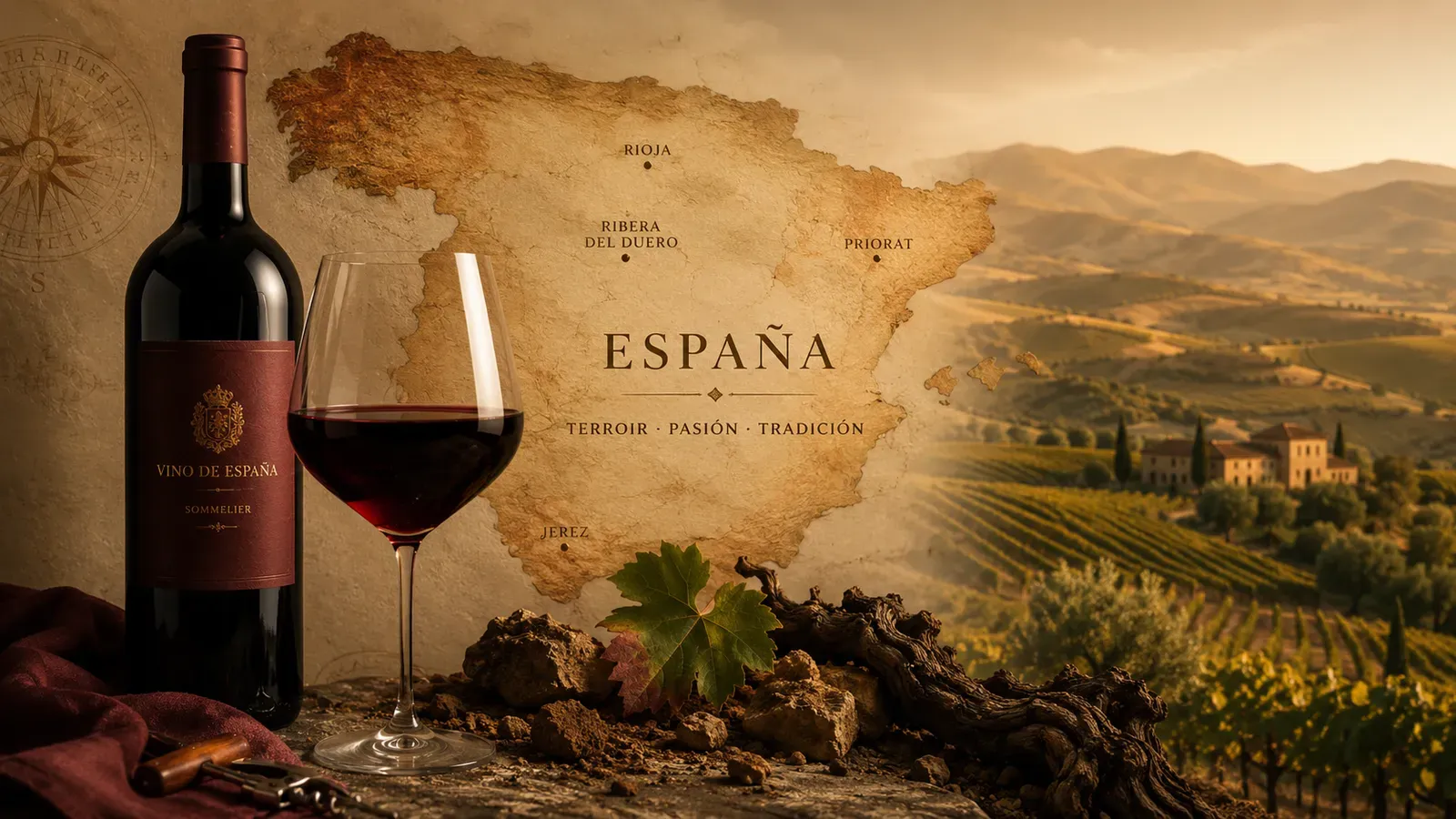

Ask for Spain’s two great powerful reds and the answer is Ribera del Duero and Priorat, the regions that put modern Spanish wine on the fine-wine map in the 1980s and 1990s. Both make deep, serious, age-worthy reds that command serious prices, and both are routinely held up as Spain’s answer to the world’s great structured wines. But they are not the same wine in two postcodes: their power comes from opposite sources, altitude in one, slate in the other, and different grapes, and the difference decides which one a given evening, and a given palate, actually wants. This page sets them side by side on soil, grape, style and price, and ends with which to pour.
Two roads to power
The regions reach intensity by opposite routes, and that is the whole comparison. Ribera del Duero sits high on the cold continental plateau of Castile, where its council documents some of Europe’s highest serious vineyards, and its power comes from altitude: hot days ripen the Tempranillo deeply while cold nights lock in acidity and structure, giving dark, firm, fresh-edged reds. Priorat, in Catalonia, builds power from soil: its vines grow on llicorella, the dramatic slate-and-quartz terraces that the DOQ protects, where ancient low-yielding vines drive roots deep into the rock and concentrate everything. Ribera’s power is altitude-fresh; Priorat’s is slate-mineral. Same intensity, opposite origins.
The grapes and the style
Grape follows soil here. Ribera del Duero is Tempranillo country, called Tinto Fino locally, the grape’s structured, dark-fruited profile giving the region its blackberry, leather and firm-tannin signature, often polished with French oak into something classically structured and ageworthy. Priorat runs on old-vine Garnacha and Cariñena, the Mediterranean grapes that the slate concentrates into dense, mineral, powerfully grippy wines with a smoky, crushed-rock character no other region matches. The result is two different kinds of serious: Ribera the darker, firmer, more classically built red, Priorat the more mineral, intense, singular one. A Bordeaux lover often leans Ribera; a drinker chasing pure terroir intensity often leans Priorat. The grape geography deserves one more line: Ribera permits a little Cabernet, Merlot and Malbec alongside its dominant Tempranillo, while Priorat’s blends lean on Garnacha and Cariñena with Syrah and Cabernet in some cellars, so a buyer reading a back label can predict the style from the grapes as much as the region.
How the two regions rose, and what it means
Both regions are young as fine-wine names, and their parallel rise explains a lot about the wines. Ribera del Duero had ancient vines and one legendary estate for a century, but only earned its denomination in 1982 and exploded internationally in the decades after, as a wave of producers showed what high-altitude Tempranillo could do. Priorat’s revival is even more dramatic and more recent: a near-abandoned region of crumbling slate terraces was reborn from the late 1980s by a small group of pioneers who saw what the old Garnacha and Cariñena vines on llicorella could become, and within a decade Priorat was one of only two Spanish regions, with Rioja, to hold the top DOQ classification. That shared story of recent, ambitious reinvention is why both regions price like fine wine and both reward serious attention, and it is also why their best bottles are still being defined rather than settled, which makes following them a live pleasure rather than a museum visit.
| Ribera del Duero | Priorat | |
|---|---|---|
| Power from | High-altitude plateau | Llicorella slate |
| Main grapes | Tempranillo (Tinto Fino) | Old-vine Garnacha, Cariñena |
| Signature | Blackberry, leather, firm structure | Crushed rock, smoke, mineral grip |
| Style | Dark, structured, ageworthy | Dense, mineral, intense |
| Climate | Cold continental, big day-night swing | Warm Mediterranean, extreme slate |
| Leans toward | Bordeaux lovers | Terroir-intensity seekers |
Price, ageing and value
Both are premium regions, and both earn it, but the value picture differs. Ribera del Duero spans a wide range, from accessible crianzas to some of Spain’s most expensive cult bottles, so a serious Ribera is findable at many price points, and its structured Tempranillo ages beautifully over a decade and more, the same cellar logic the Rioja-versus-Bordeaux guide runs for ageworthy Spanish reds. Priorat is smaller, its heroic slate viticulture is labour-intensive and low-yielding, and its prices start higher and climb fast, with the top wines among Spain’s most expensive. Both reward cellaring; both are wines for a serious occasion rather than a weeknight. The honest value note is that Ribera offers more entry points, while Priorat offers a singularity that justifies its premium for those chasing it. Serving rewards both with air and the right glass: open these structured reds an hour ahead, pour them into a large bowl at sixteen to eighteen degrees, and the young examples especially soften and open across the evening, while the slate of a Priorat needs that air to lift its perfume above its grip.
Which to pour
The choice follows the evening and the palate. For a classically structured red to serve with lamb, beef or a slow roast, or to cellar for a decade, Ribera del Duero is the more versatile and food-friendly answer, its dark fruit and firm tannin built for the table, and from the portfolio Acediano and Naluar’s tinto fino bring the region’s structure. For the slate-mineral experience, the dense, crushed-rock intensity Priorat made famous, our own slate-grown reds deliver it without the Priorat premium: Acediano from slate terraces carries the iron and mineral grip, the Bierzo Mencía the cooler, stonier face of the same rock, and the Extremadura Garnacha the dark, savoury concentration, the same mineral logic the Priorat soils page maps in depth. Priorat keeps the famous name; the slate idea is already on our shelf. Both regions deliver their education across the Netherlands from the shop; for the everyday structured red, the Rioja-versus-Ribera comparison covers the gentler end of the spectrum. Wine is for adults of eighteen and over.
At the table, the two powers split
Power is not one thing at dinner, and the two styles want different plates. Ribera del Duero’s structured, dark-fruited Tempranillo is the more straightforwardly food-friendly: it is built for lamb, beef and slow roasts, its firm tannin scrubbing fat and its altitude-fresh acidity keeping the third bite as good as the first, which is why the region’s home tables are asador tables of meat over wood. Our Acediano is the bottle for that dinner. The slate-mineral red is the more particular partner: its crushed-rock intensity and grip want food with equal depth and a little fat to soften the edges, game, oxtail, aged hard cheese, mushroom-rich winter dishes, rather than a delicate plate it would flatten. It is also the red most worth drinking slowly and nearly alone, the way the slate logic rewards contemplation, so a smaller pour beside a cheese course often beats a full glass with a busy main. Match the weight of the plate to the weight of the wine and both powers find their place; mismatch them and the wine either bullies the food or vanishes under it.
Serving these power reds right
Both styles are built on structure, and structure rewards a little patience at the table. Open them an hour ahead, or decant a young bottle, because air is what softens firm tannin and lifts perfume above grip, and the slate-grown reds especially need that breath to open. Serve at sixteen to eighteen degrees in a large-bowled glass, cooler than a warm room, because heat next to a powerful red reads as alcohol and flattens the freshness that altitude or slate worked to build. On ageing, both styles are made to cellar: a serious Tempranillo deepens over a decade into leather and dried fig, while the slate reds hold their mineral grip for years and only resolve slowly, so a buyer laying a few down should expect to wait and be rewarded. The single most common mistake with both is impatience, opening a structured young bottle cold and undecanted, which shows the tannin before the fruit. Give them air, give them a cool sixteen degrees, and the power these regions are famous for arrives as depth rather than weight.
The one-sentence version
Ribera del Duero and Priorat are Spain’s two power reds by opposite roads: Ribera’s structured, ageworthy Tempranillo built on cold altitude, Priorat’s dense, mineral Garnacha built on slate, the choice being altitude-fresh power against slate-mineral power, the latter on our shelf as slate-grown reds without the Priorat premium.